Prim's Algorithm
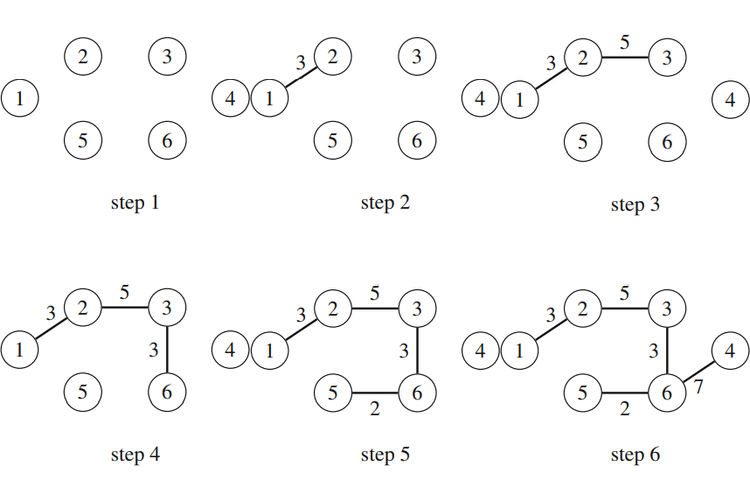
Prim’s algorithm is an alternative method for constructing minimum spanning trees. The algorithm first adds an arbitrary node to the tree, and then always chooses a minimum weight edge that adds a new node to the tree. Finally, all nodes have been added and a minimum spanning tree has been found.
Prim’s algorithm resembles Dijkstra’s algorithm. The difference is that Dijkstra’s algorithm always selects a node whose distance from the starting node is minimum, but Prim’s algorithm simply selects a node that can be added to the tree using a minimum weight edge.
 |
|---|
| Fig. 43: Prim’s algorithm |
As an example, Fig. 43 shows how Prim’s algorithm constructs a minimum spanning tree for our example graph, assuming that the starting node is node 1. Like Dijkstra’s algorithm, Prim’s algorithm can be efficiently implemented using a priority queue. The priority queue should contain all nodes that can be connected to the current component using a single edge, in increasing order of the weights of the corresponding edges.
The time complexity of Prim’s algorithm is that equals the time complexity of Dijkstra’s algorithm. In practice, Prim’s and Kruskal’s algorithms are both efficient, and the choice of the algorithm is a matter of taste. Still, most competitive programmers use Kruskal’s algorithm