Graph Terminology
info
In this course we will use variable n as number of nodes and variable m as number of edges.
The nodes will be numbered using integers 1, 2, ..., n.
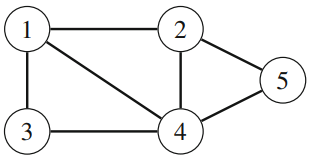
Fig. 1 shows a graph example with 5 nodes and 7 edges.
 |
|---|
| Fig. 1: Graph with 5 nodes and 7 edges |
Length of a path
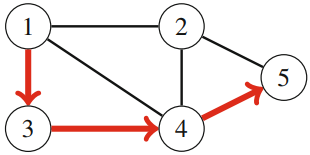
The length of a path is the number of edges in it. For example, Fig. 2 shows a path of length 3 from node 1 to node 5.
 |
|---|
| Fig. 2: A path from node 1 to node 5 |
Cycle in a graph
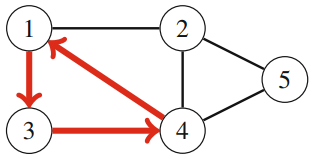
A cycle is a path where the first and last node is the same. For example, Fig. 3 shows a cycle .
 |
|---|
| Fig. 3: A cycle of three nodes |
Connected graph
A graph is connected if there is a path between any two nodes. In Fig. 4, the left graph is connected, but the right graph is not connected, because it is not possible to get from node 4 to any other node.
|
|---|
| Fig. 4: The left graph is connected, the right graph is not |
The connected parts of a graph are called its components. For example, the graph in Fig. 5 has three components: {1, 2, 3}, {4, 5, 6, 7}, and {8}.
|
|---|
| Fig. 5: A graph with three components |
Tree
A tree is a connected graph that does not contain cycles. Figure 6 shows an example of a graph that is a tree.
 |
|---|
| Fig. 6: A Tree |
Directed graph
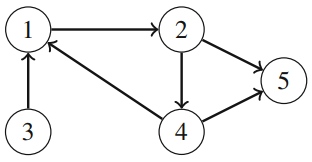
In a directed graph, the edges can be traversed in one direction only. Figure 7 shows an example of a directed graph. This graph contains a path from node 3 to node 5, but there is no path from node 5 to node 3.
 |
|---|
| Fig. 7: A directed graph |
Weighted graph
In a weighted graph, each edge is assigned a weight. The weights are often interpreted as edge lengths, and the length of a path is the sum of its edge weights. For example, the graph in Fig. 8 is weighted, and the length of the path is . This is the shortest path from node 1 to node 5.
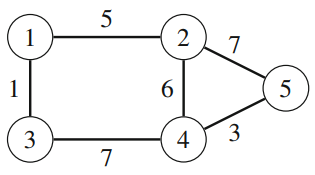 |
|---|
| Fig. 8: A weighted graph |
Neighbors or adjacent nodes
Two nodes are neighbors or adjacent if there is an edge between them.
Degree of a node
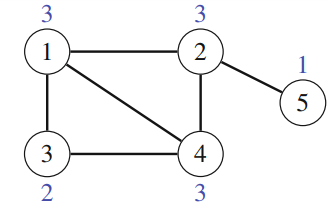
The degree of a node is the number of its neighbors. Figure 9 shows the degree of each node of a graph. For example, the degree of node 2 is 3, because its neighbors are 1, 4, and 5.
The sum of degrees in a graph is always 2m, where m is the number of edges, because each edge increases the degree of exactly two nodes by one. For this reason, the sum of degrees is always even.
 |
|---|
| Fig. 9: Degrees of nodes |
Regular graph
A graph is regular if the degree of every node is a constant d.
Complete graph
A graph is complete if the degree of every node is n − 1, i.e., the graph contains all possible edges between the nodes.
Indegree and Outdegree
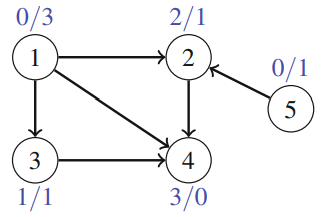
In a directed graph, the indegree of a node is the number of edges that end at the node, and the outdegree of a node is the number of edges that start at the node. Figure 10 shows the indegree and outdegree of each node of a graph. For example, node 2 has indegree 2 and outdegree 1.
 |
|---|
| Fig. 10: Indegrees and outdegrees |
Bipartite graph
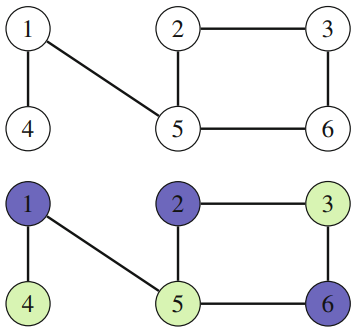
A graph is bipartite if it is possible to color its nodes using two colors in such a way that no adjacent nodes have the same color. It turns out that a graph is bipartite exactly when it does not have a cycle with an odd number of edges. For example, Fig. 11 shows a bipartite graph and its coloring.
 |
|---|
| Fig. 11: A bipartite graph and its coloring |