Graph Representation
There are three classical ways to represent a graph. The choice of a data structure depends on the size of the graph and the way the algorithm processes it.
- Adjacency List
- Adjacency Matrix
- Edge List
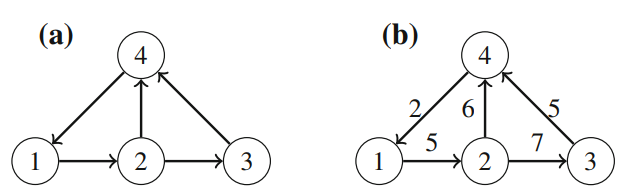 |
|---|
| Fig. 12: Example graphs |
Adjacency List
In the adjacency list representation, each node x of the graph is assigned an adjacency list that consists of nodes to which there is an edge from x. Adjacency lists are the most popular way to represent graphs, and most algorithms can be efficiently implemented using them.
Example: for graph (Fig 12(a))
// Declaration of Adjacency List
vector<int> adj[N];
// Building Adjacency List
adj[1].push_back(2);
adj[2].push_back(3);
adj[2].push_back(4);
adj[3].push_back(4);
adj[4].push_back(1);
If the graph is undirected, it can be stored in a similar way, but each edge is added in both directions.
For a weighted graph, the adjacency list of node a contains the pair (b,w) always when
there is an edge from node a to node b with weight w.
Example: for graph (Fig 12(b))
// Declaration of Adjacency List
vector<pair<int,int>> adj[N];
// Building Adjacency List
adj[1].push_back({2,5});
adj[2].push_back({3,7});
adj[2].push_back({4,6});
adj[3].push_back({4,5});
adj[4].push_back({1,2});
Adjacency Matrix
An adjacency matrix indicates the edges that a graph contains. We can efficiently check from an adjacency matrix if there is an edge between two nodes. The matrix can be stored as an array int adj[N][N]; where each value adj[a][b] indicates whether the graph contains an edge from node a to node b. If the edge is included in the graph, then adj[a][b] = 1, and otherwise adj[a][b] = 0.
Example: for graph (Fig 12(a))
If the graph is weighted, the adjacency matrix representation can be extended so that the matrix contains the weight of the edge if the edge exists.
Example: for graph (Fig 12(a))
The drawback of the adjacency matrix representation is that an adjacency matrix contains elements, and usually most of them are zero. For this reason, the representation cannot be used if the graph is large.
Edge List
An edge list contains all edges of a graph in some order. This is a convenient way to represent a graph if the algorithm processes all its edges, and it is not needed to find edges that start at a given node.
Example: for graph (Fig 12(a))
// Declaration of Edge List
vector<pair<int,int>> edges;
// Building Edge List
edges.push_back({1,2});
edges.push_back({2,3});
edges.push_back({2,4});
edges.push_back({3,4});
edges.push_back({4,1});
If the graph is weighted, then each element in this list is of the form (a, b, w), which means that there is an edge from node a to node b with weight w.
Example: for graph (Fig 12(b))
// Declaration of Adjacency List
vector<tuple<int,int,int>> edges;
// Building Adjacency List
edges.push_back({1,2,5});
edges.push_back({2,3,7});
edges.push_back({2,4,6});
edges.push_back({3,4,5});
edges.push_back({4,1,2});