Dynamic programming
Using dynamic programming, we can efficiently answer many questions regarding paths in directed acyclic graphs. Examples of such questions are:
- What is the shortest/longest path from node
ato nodeb? - How many different paths are there?
- What is the minimum/maximum number of edges in a path?
- Which nodes appear in every possible path?
Number of paths
Number of paths from node a to node b:
Let paths(x) denote the number of paths from node a to node x. As a base case, paths(a) = 1. Then, to calculate other values of paths(x), we can use the recursive formula
, where are the nodes from which there is an edge to x. Since the graph is acyclic, the values of paths can be calculated in the order of a topological sort.
 |
|---|
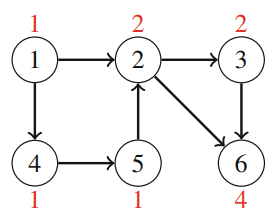
| Fig. 29: Calculating the number of paths from node 1 to node 6 |
Fig. 29 shows the values of paths in an example scenario where we want to calculate the number of paths from node 1 to node 6. For example,
because the edges that end at node 6 are and . Since paths(2) = 2
and paths(3) = 2, we conclude that paths(6) = 4. The paths are as follows:
Processing Shortest Paths
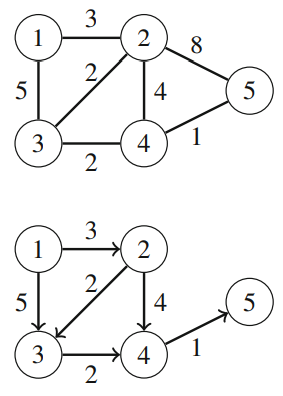
Dynamic programming can also be used to answer questions regarding shortest paths in general (not necessarily acyclic) graphs. Namely, if we know minimum distances from a starting node to other nodes (e.g., after using Dijkstra’s algorithm), we can easily create a directed acyclic shortest paths graph that indicates for each node the possible ways to reach the node using a shortest path from the starting node. For example, Fig. 30 shows a graph and the corresponding shortest paths graph.
 |
|---|
| Fig. 30: A graph and its shortest paths graph |
Coin Problem
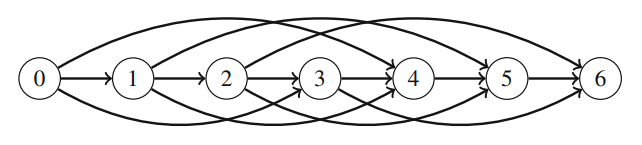
In fact, any dynamic programming problem can be represented as a directed acyclic graph where each node corresponds to a dynamic programming state and the edges indicate how the states depend on each other.
 |
|---|
| Fig. 31: Coin problem as a directed acyclic graph |
For example, consider the problem of forming a sum of money n using coins . In this scenario, we can construct a graph where each node corresponds to a sum of money, and the edges show how the coins can be chosen. For example, Fig. 31 shows the graph for the coins {1, 3, 4} and n = 6. Using this representation, the shortest path from node 0 to node n corresponds to a solution with the minimum number of coins, and the total number of paths from node 0 to node n equals the total number of solutions.